Monday, June 10, 2013

HIstorical Questions


Division of class and hierarchy in Paris, France

  • There is an array of characters in this show, many of which from different classes.  An interesting question would be is the boatman viewed better than the artist George.  How would a shopgirl differ from a maid in a house.


The art world of 1860s, impressionism vs. pointillism

The industrial revolution, the Eiffel Tower


The real life of George Seurat vs. the fiction of the play

  • The life of George Seurat is very different than what is presented in the stage play.  There are many parallels but nothing is true to form.  The musical is based upon the finished painting rather than his life itself.
  • http://www.georgesseurat.org/

The art world of the mid 1980s


Thursday, June 6, 2013

Additional Resources

  • Hall, Sharon K. "Sunday in the Park with George by James Lapine and Stephen Sondheim."Contemporary Literary Criticism 39 (1986): 172-75. Literature Criticism Online. Web.
This is a collection of short essays written about the musical Sunday in the Park with George.  None of these people particularly liked the musical.  It is important to understand why this show is not liked to fully appreciate this piece as a whole.  PDF
 
  • Young, Toby. "Change of heart." Spectator 10 Dec. 2005: 62+. Literature Resource Center. Web. 14 June 2013.
An interesting criticism of the libretto of Sunday in the Park with George.  The reviewer believes me in thinking that the script is flawed and that the second act comes completly out of left field when relatd to the rest of the work.  Although he goes on to say that the second act serves it's purpose in teh overall theme the authors original intention was, which was to solve this question; "whether a work of art that concerns itself with ideas and is created in a cold, mechanical way, such as Seurat's masterpiece that forms the centrepiece of the first half, can evoke an emotional response."  Toby Young's answer, yes.

  • Leithauser, Brad. "A Funny Thing Happened on the Way to Broadway." New York Review of Books (10 Feb. 2000): 35-49. Rpt. in Contemporary Literary Criticism. Ed. Jeffrey W. Hunter. Vol. 147. Detroit: Gale Group, 2002. Literature Resource Center. Web. 14 June 2013.
"In the following essay, Leithauser examines Sondheim's strong professional recognition despite the lack of finality in his productions, his dark motifs, his use of rhyme, and his complex characterizations."  Interesting read.  A critique of Sondhiem's entire body of work and how his subject matter is uncommon for the modern Broadway musical, the author does go into some detail on into Sunday in the Park wirh George.  He comments that the show "enchant[s] rather than ... resolve[s]."  A wonderful analysis of some songs lyrics.  I am constantly amazed.

  • Van Leer, David. "Putting It Together: Sondheim and the Broadway Musical." Raritan 7.2 (Fall 1987): 113-128. Rpt. in Drama Criticism. Ed. Timothy J. Sisler. Vol. 22. Detroit: Gale, 2004. Literature Resource Center. Web. 14 June 2013.
"In the following essay, Van Leer elucidates the reasons for the mixed critical and popular reaction to Sondheim's musicals."  A criticism of Sondhiem's work, although I might say I do not agree with them.  He geneally praises the musical but relates to the completity of the two leads, George and Dot "at about the same level of complexity as Curley and Laurie in Oklahoma!"  I just can not jump on that band wagon.  The critique below gos into more detail on this subject.

  • Rich, Frank. "Sunday in the Park with George: New Musical." The New York Times (3 May 1984): C21. Rpt. in Contemporary Literary Criticism. Ed. Jean C. Stine and Daniel G. Marowski. Vol. 30. Detroit: Gale Research, 1984. Literature Resource Center. Web. 14 June 2013.
A critical analysis of the show Sunday in the Park with George itself.  I found this sentance most interesting, "As is often the case in Sondheim musicals, we don't care about the characters—and here, more than ever, it's clear we're not meant to care."  Since you see the characters through the eyes of a emotionally detached artist, the characters are not important, the creation of the work is.  The author brings up a lot of interesting things to think about, however brief the article is.

Wednesday, June 5, 2013

Exegesis

Setting
Act 1, a park on the island in the Seine just outside Paris
The setting of the first act is the island of IIe de la Jatte which is an island in France, in the river Seine, at the very gates of Paris.


  • Page 18, Dot wears a traditional 19th century outfit: full length dress with bustle, etc.
A bustle is a type of framework used to expand the fullness or support the drapery of the back of a woman's dress.  The time period of the play, a “late bustle” would be worn, which means it is a more exaggerated look than from previous years.  Wikipedia


  • Page 24, Dot, “The tip of a stay”
A stay in this case would be the noun, meaning a flat strip of steel, plastic, etc., used especially for stiffening corsets, etc.


  • Page 27, Franz, “Jungen!  Nicht so laut!  Ruhe, bitte!”
German for “Boys!  Not so loud! Quiet, please!”  Pronunciation.


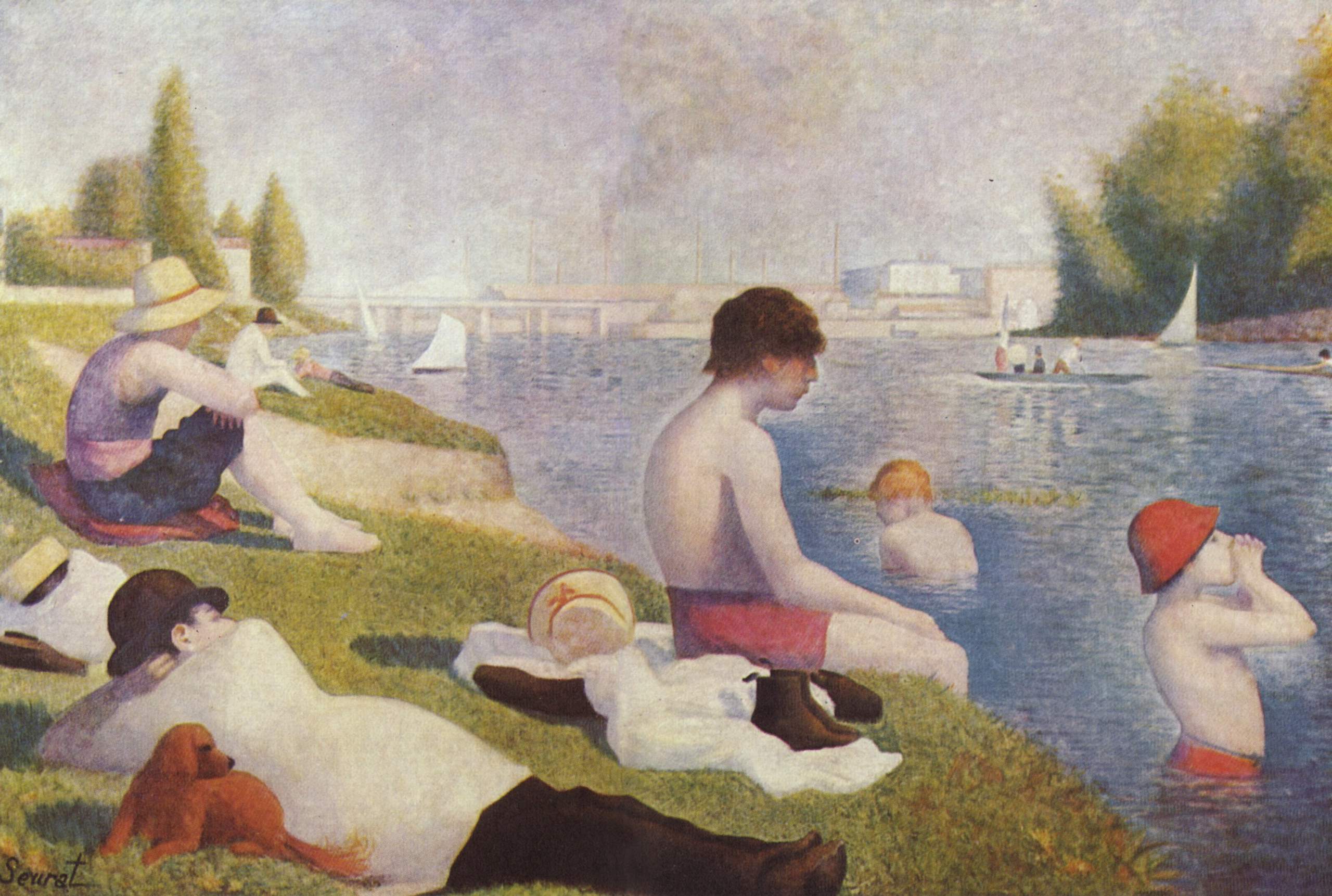
  • Page 27, An actor recreation of Steuat’s Bathers at Asnières is seen on stage

  • Page 27, The Young Man gives a loud Bronx Cheer
A “Bronx Cheer” is another phrase for “blowing a raspberry.”   Demonstration

  • Page 28, Jules, “It’s neither pastoral.  Nor lyrical.  You don’t suppose that it’s satirical?” 
These are references to different types of artistic styles popular at the time of the play.  Pastoral is a form of glorifying the farm life and nature.  Lyrical is in a sense abstract painting, it became more popular in the 1940s.  Satire is a way of using humor and taboo subjects to get ones point across.

  • Page 29, Yvonne, “It might be in some dreary Socialistic periodical.”
Socialism is hard to put into one easy definition.  But it was on the rise when the Industrial Revolution kicked in.  To get their views heard they would produce periodicals throughout the year, which in a sense are magazines.  Many people did not take these beliefs seriously.  Wikipedia.

  • Page 32, Dot, “We’ll go to the Follies tonight.”
This is most likely referring to the popular French theatre The Folies Bergère.  Famous for its elaborate costumes; the women's were frequently revealing, practically leaving them naked, and shows often contained a good deal of nudity.

  • Page 33, It is mentioned in stage directions that Dot sits at her vanity in the style of the painting La Poudreuse (Young Woman With Powder Puff)

  • Page 36, Dot, “Fancy young aristocrats with fancy flats…”
    An aristocrat is a nobleman, a member of the elite, has taste, manners, etc.  It is no wonder that Dot thinks of spending time with them.  Pronunciation. 

Tuesday, June 4, 2013

Play Analysis

James Lapine, Librettist 

Interestingly enough, James Lapine originally majored in History at the Franklin and Marshall College in Lancaster, Pennsylvania.  He went on to get an MFA in Design from the California Institute of the Arts in Valencia, California.  After grad school he moved to New York where he held an assortment of part time and freelance jobs.  He eventually got a teaching position at Yale as an advertising design professor.  There he had the experience to direct a play during the annual January period when both faculty and students undertook a project outside of their areas of study or expertise.  He then changes his career to peruse theatre full time.  His credits span far and wide as a playwright, a director in both film and theatre.  He has been nominated for a Tony Award a total or 10 times, winning 3 of them.    IBDB.com     JamesLapine.com


Sunday in the Park with George, a Book Musical in Two Acts 
Synopsis

Act I.     A Sunday in Paris in 1884. Georges, an artist, is seated in a park on the island of La Grande Jatte. Georges starts to draw. For Dot, his model and long-suffering lover, standing in the sun, it's just another day.

In the painter's studio, Dot sits at a vanity mirror powdering her face, while, in an identical rhythm, Georges dabs spots of red and purple and white on his new painting. She is preparing to go to the Follies with him, but his painting proves more important -he has to stay to finish a hat. Dot leaves in a rage, realizing that for Georges, his art will always come first.

Returning to the park on another Sunday sometime later, Georges. paints two women called Celeste as gossip about these poor deluded artists. Dot, pregnant, has a new lover, a baker called Louis. True, he's not what she had in mind, but, in a way, his pastries are works of art.

Georges is sorry Dot has left, but that is his life: he watches the world go by, while he sits at his easel, lost in some tiny detail. When she comes by with their child, he does not even look up. Dot and Louis will take the baby to America.

In the park, the Old Lady - Georges' mother - urges him to paint, and preserve, everything that is beautiful before it disappears, before new buildings obliterate the trees. Even as Georges insists that change is beautiful, his mother pines for the old view. Around him, the park fills with characters, squabbling and fighting until Georges calls for "order" and "balance". He commences to re-arrange the people and the trees and, from the chaos, assembles a peaceful promenade on La Grande Jatte. Harmony at last. As the fractious ensemble comes together to form his painting, Georges freezes his models in their final poses.

Act II.     It is now 1984 and Georges' work is on exhibition in America, where his and Dot's daughter Marie, as old as the painting, have come to see it.

With her is her grandson, another George, another artist. Although he's never really believed that the woman in the picture is his grandmother, his latest commission, a big white electrical machine with a sphere on top called Chromolume #7, is his own way of commemorating the famous painting. George and Marie narrate the history of Georges Seurat. After the performance the museum's Director announces that the new condominium development above the gallery is now open for viewing. The inconsequential chit-chat is depressing, but necessary. George is making connections which can lead to exhibitions. As the glittering guests drift off to dinner, Marie looks at her mother in the painting, and trying to relate her to her young grandson.

But Marie dies and George is invited to present his Chromolume in Paris. The island of La Grande Jatte is now a cacophony of concrete towers and the park his supposed great-grandfather painted has dwindled away to a tiny patch of grass. George misses Marie. And, as he thinks of her, Dot appears.

Despite his protestations that he has nothing more to say in his art, she urges him to move on and, as he reads the words Dot's Georges scribbled in her book a century ago, the original promenaders re-convene for one more perfect Sunday. George looks again at the book: "A black page or canvas. His favorite. So many possibilities . . . " The stage fades to white, and Dot slowly disappears.   SOURCE

CHARACTERS

Act 1, 1884:
Georges - An artist, bearded and brooding, and determined to perfect a new technique of painting
Dot - Georges' model, mistress and the mother of his child
Jules - Another painter, popular and wealthy at the time
Yvonne - Jules' wife
Louise - Their daughter
An Old Lady - A regular stroller in the park and also Georges' mother, though she's not eager to advertise the relationship
The Old Lady's Nurse
Celeste #1, Celeste #2 - Two pretty gossips
Louis - A baker who kneads dough and needs Dot
Mr and Mrs - Two crass tourists from the United States
Franz - A servant
Frieda - A cook
A Boatman - The owner of a black dog, Spot

Act 2, 1984:
George - An artist, but one who spends more time massaging potential sources of commissions than his predecessor.
Marie - Dot's daughter by the first Georges, now old and wheelchair-bound
Bob Greenberg - A museum director, preoccupied keeping up with the new
Naomi Eisen - Composer of the music for Georges' Chromolume presentations
Blair Daniels - An art critic who once championed George but now thinks he's just repeating himself
Harriet Pawling - A wealthy patron of the arts
Elaine - Georges' ex-wife
Billy Webster - A friend of Harriet's
Lee Randolph - The museum's publicist
Dennis - A technician at the museum
Betty and Alex - Other artists
Charles Redmond - A visiting curator of the County commissions to dispense


ARTICLES OF INTEREST

·         Gottfried, Martin. "Everybody's Got The Right To Be Different." Sondheim. New York: H.N. Abrams, 1993. 155-66. Print.
This is a great book which includes a brief description of the making of the show as well as an in depth analysis of the piece as a whole.  (I own this book, I found it very helpful but could not find it for free online.)   Amazon.com


·         Swain, Joseph P. "Sondheim's Broadway Musicals." Music & Letters 76.1 (1995): 132-35.Oxford University Press. Web.
A critical analysis of Sondheim’s shows on Broadway also including opinions from other reviews and essays written.   PDF   


·         Sondheim’s Sunday: Art, Broadway Musicals, and Personal Relationships by Sandor Goodhart, Ph.D.
This is a transcript of a lecture delivered at the Chicago Shakespeare Theater on October 19, 2012.  It goes into detail about what the show is about and how all the themes of the show fit together as a whole.  PDF


·         Sunday In The park With George: A Musical Curation By Amy Riordan
This analysis serves to reveal the strong interconnectedness between museums and theatre ... Sondheim redirects the focus from Seurat's innovative pointillist style to a focus on the relationship between artist and artwork, allowing for artist and painting to converse.   PDF


Monday, June 3, 2013

The Physical Script


LIBRARY OF CONGRESS

Collections

Marx, Robert. Famous American Plays of the 1980s. New York: Dell, 1988. Print.
ISBN   0440201500 (pbk.)
LC classification (full)   ‪CPB Box no. 1785 vol. 3

Sondheim, Stephen, Burt Shevelove, Larry Gelbart, Hugh Callingham Wheeler, James Lapine, Christopher Bond, and Albert Hirschfeld. Four by Sondheim, Wheeler, Lapine, Shevelove and Gelbart: A Funny Thing Happened on the Way to the Forum, A Little Night Music, Sweeney Todd and Sunday in the Park with George. New York, NY: Applause, 2000. Print.
LCCN   ‪00100279


SHSU NEWTON GRAHM LIBRARY

Sondheim, Stephen, and James Lapine. Sunday in the Park with George. New York, NY: Applause Theatre, 1991. Print.
ISBN   1557830673
LC classification (full)   ML50.S705 S8 1991

RETAIL
Newest Paperback
Sunday in the Park with George.  (Applause Theatre & Cinema Books, 2000.)
Amazon.com $12.25

Kindle Edition
Amazon.com $11.64

ACTING EDITIONS (not available for retail purchase)
Sunday in the Park With George.  Two Acts, Book Musical. Rated G.

Background of Libretto:  When Sunday in the Park with George was first produced, it was incomplete.  The first act was incomplete (“Everybody Loves Louis,” “Beautiful,” and “Finishing the Hat” were added during the run) and hardly had any act two.  It was decided to only perform the first act.   During this development period the show was completed.  It was only performed in it’s entirely before opening on Broadway 3 times.  The show’s libretto won the 1985 Pulitzer Prize for Drama, one of only 8 musical to do so.  Wikipedia